Blog
Contractor accommodation near Port Talbot steelworks: supporting the EAF build
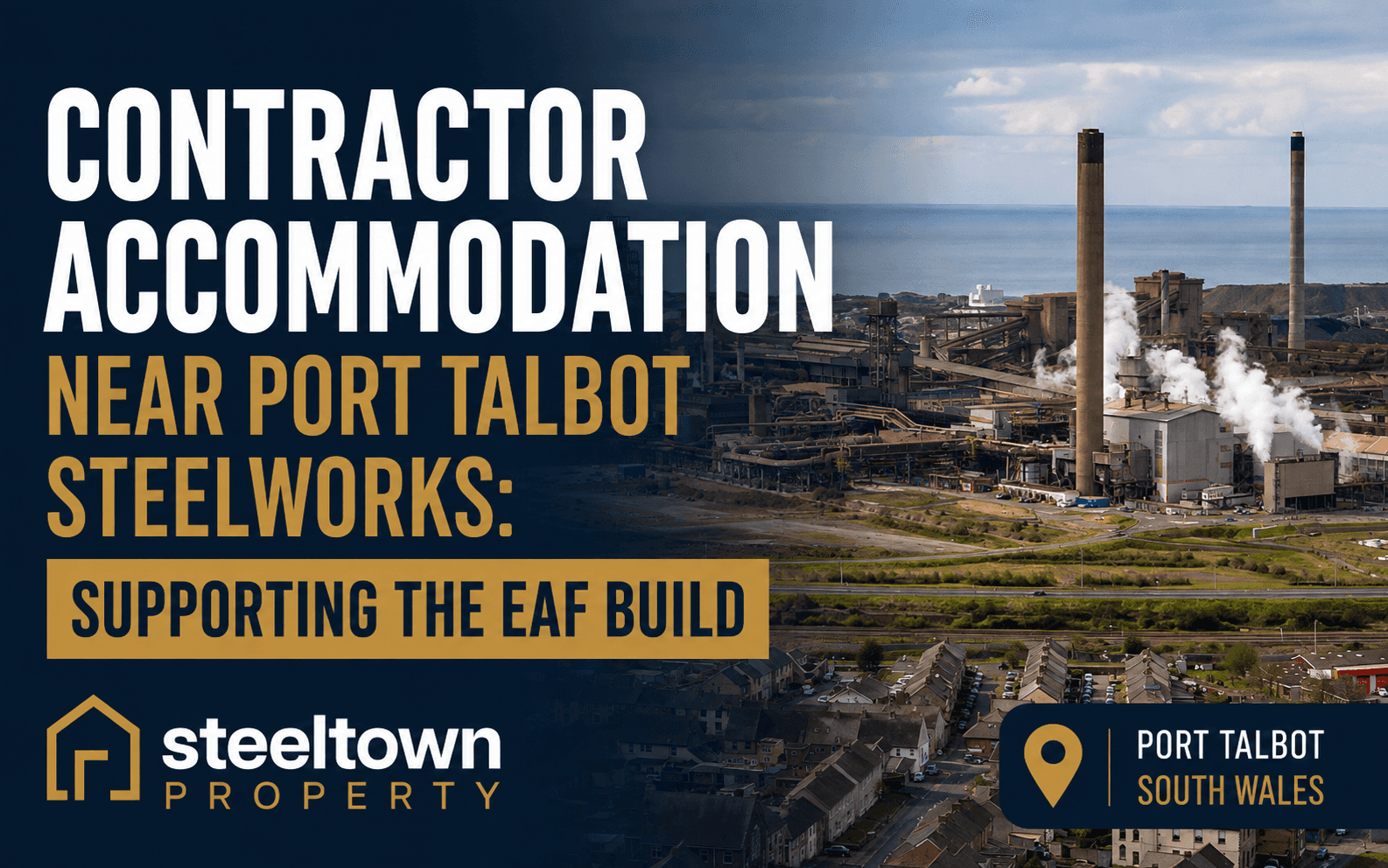
Port Talbot is going through the most significant industrial transition the town has seen in decades. The closure of the blast furnaces and the move toward electric arc furnace (EAF) steelmaking has reshaped both the workforce on site and the demand for contractor accommodation across the surrounding area.
This is a grounded look at what is actually happening and what it means for contractor accommodation in Port Talbot — based on operating in the town day to day, not on speculation.
The blast furnace closure and what followed
The blast furnace operations at Port Talbot wound down through 2024, marking the end of primary steelmaking on the site in its previous form. The transition has been widely documented. The relevant point for contractor teams and their coordinators is that the site has not gone quiet. It has moved into a long, multi-year build phase that is generating more sustained contractor demand than the blast furnace era produced.
The EAF transition and what it means for contractor demand
The electric arc furnace route is a fundamentally different production model and requires a substantial construction and commissioning programme. That programme runs alongside continued downstream operations and a wider regeneration of the surrounding industrial footprint.
From an accommodation standpoint, the practical effect is sustained rather than seasonal demand. Civils packages, mechanical and electrical works, commissioning teams and supporting supply-chain contractors all generate long-stay accommodation requirements that are running in parallel rather than in sequence.
Wider regeneration adding to the baseline
Beyond the immediate steelworks, wider regeneration activity in Port Talbot — port investment, energy infrastructure and industrial estate development — adds further contractor footfall to the area. The combined effect is a town with a higher baseline of project workers than at any point in recent memory, and a local accommodation market that has had to adapt accordingly.
The signs are visible on the ground: more sign-written vans on the M4 sliproads at shift change, stronger weekday demand than weekend demand, and a steady increase in B2B accommodation enquiries from companies based outside Wales.
Why long-stay accommodation is the dominant model here
Most of the current project work around Port Talbot is not short-duration. Multi-week and multi-month placements, often with extension, are the norm rather than the exception. That has pushed demand away from hotel stays and toward serviced houses, managed properties and aparthotel-style stock configured for working teams.
Hotels in the area are limited in both capacity and suitability for contractor stays. They were not built for shift workers, van fleets or twelve-week bookings. Serviced accommodation operated by a local provider is the model that fills that gap.
Why contractor teams need flexible housing
Construction and commissioning timelines move. Contractor accommodation needs to move with them: extensions, team-size changes, mid-project rotations and occasional short-notice arrivals are all part of normal project life. Properties configured for leisure short-lets are not built for that pattern of demand, and the administrative overhead of managing them is significant.
Port Talbot: practical advantages for contractor teams
For teams coming in from outside the area, Port Talbot has practical advantages that are not always obvious before arrival:
Direct access to the main steelworks and surrounding industrial sites
M4 corridor connectivity east toward Bridgend and Cardiff, west toward Swansea
Compact town centre with everyday amenities within easy reach of most accommodation
Quiet residential streets well-suited to shift workers
Coastal proximity for downtime without major travel
Access to Swansea and the wider corridor
Swansea is 15 to 20 minutes west on the M4 and provides additional capacity when Port Talbot is at peak. Bridgend and Cardiff are reachable to the east for projects spanning multiple sites along the corridor.
The role of serviced accommodation during industrial transition
Industrial transitions on the scale of Port Talbot's generate concentrated, sustained accommodation demand that hotel stock alone cannot meet. Serviced accommodation — properly managed, set up for weekly and monthly rates, and configured for working teams — is the model that scales for this kind of work.
The demand is not a short-term spike. The EAF build and associated regeneration will generate contractor activity in Port Talbot for years. Operators set up for long-stay contractor bookings are better positioned to support that than operators whose core business is short leisure lets.
How Steeltown Property supports contractor teams in Port Talbot
We operate a serviced accommodation portfolio based in Port Talbot, with additional properties across South Wales. Our bookings are concentrated around contractor and long-stay business stays, and our operations are set up specifically for that pattern of demand.
Workforce-ready properties with off-street parking and reliable WiFi
Single point of contact for booking, extensions and on-stay support
VAT invoicing and centralised billing for multi-property bookings
Weekly and monthly rates structured for long-stay contractor work
Local knowledge of routes, sites and residential areas across the town
For a wider view of the regional market, see our complete guide to contractor accommodation in South Wales.
Local knowledge and why it matters
Operating from Port Talbot rather than a remote platform is the operational difference that matters most at the detail level. Knowing which routes back up at 6am, which streets are quiet enough for night-shift workers, and which properties suit the crew configuration on a given project takes years to build. It is not something a national booking platform can replicate from a listing page.
Frequently asked questions
Is there enough contractor accommodation in Port Talbot?
Capacity is tighter than it was two years ago and varies week to week depending on active mobilisations. Booking ahead — particularly for larger teams — is the most reliable way to secure suitable properties. For teams of six or more, four to six weeks' notice is advisable during peak periods.
Do you accept long-stay contractor bookings?
Yes. Long-stay weekly and monthly bookings are the core of our work in Port Talbot. Extensions are accommodated wherever availability allows, and we flag extension risk early where we can see potential pressure on specific properties.
Can you accommodate teams working on the EAF programme?
Yes. We support contractor and engineering teams working across Port Talbot, including those associated with the steelworks transition and wider site regeneration. Send an accommodation request with team size, dates and vehicle count and we will respond with options within one business day.
How do bookings work for teams arriving at short notice?
Short-notice enquiries are handled as a priority. We cannot always guarantee availability for same-week mobilisations during busy periods, but we will always respond quickly and give you an honest picture of what is available and at what rate.
What is the minimum stay for contractor accommodation in Port Talbot?
Our contractor bookings are weekly or monthly. We are not a short-break operator. The minimum practical booking is one week, and most of our Port Talbot bookings run considerably longer than that.


